
New home builder incentives can save you real money
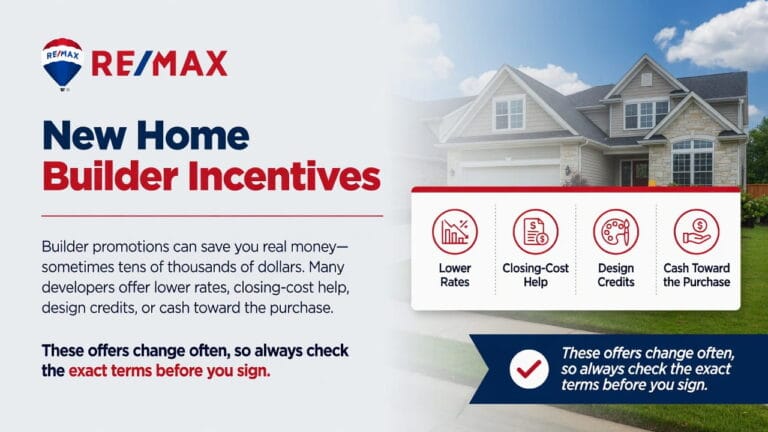
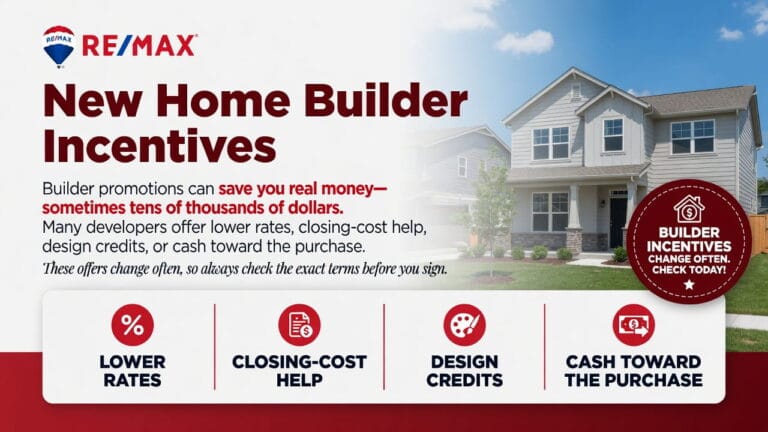
New home builder incentives can save you real money—sometimes tens of thousands of dollars.
Many new house developers offer lower rates, closing-cost help, design credits, or cash toward the purchase.
These new construction homes offers change often, so always check the exact terms before you sign.
Common types of new home builder incentives
- Temporary interest rate buydowns (1-0, 2-1, or 3-2-1)
- Permanent rate reductions or special fixed-rate financing
- Closing-cost credits
- Design-center credits for flooring, cabinets, counters, and appliances
- Flex cash toward the purchase
- Base-price discounts
- Free or reduced upgrades such as taller ceilings or larger garages
- Lot-premium reductions
- Longer rate locks
- Matching help for state or local down-payment programs
- Energy-efficiency rebates that can stack with other offers
- Extra packages on homes that are already built or nearly finished
Example of a 2-1 rate buydown
Loan amount: $400,000 Permanent rate: 6.5% 30-year fixed loan
With a 2-1 buydown (usually paid by the new home builder):
- Year 1: 4.5% → about $2,027 per month (principal and interest)
- Year 2: 5.5% → about $2,271 per month
- Year 3 and after: 6.5% → about $2,528 per month
You get lower payments for the first two years.
After that, the payment rises to the full rate.
Always run the exact numbers with a lender. Taxes, insurance, and association fees are extra.
How to get the most value
- Use the builder’s preferred lender if required, then refinance later when rates improve. First make sure there is no prepayment penalty. You can still get pre-approved with another lender so you are ready.
- Ask if state or local down-payment help can combine with the builder’s offer. Some allow it. Run the full math either way. A steady rate with fewer credits can sometimes beat a temporary low rate with big credits.
- Look at new homes that are already built or nearly finished. Standing inventory usually comes with stronger credits and better rate help because the builder wants those houses sold.
- Shop near the end of a quarter. Public companies report results then, and that often creates more room to negotiate.
- Compare the true long-term cost, not just the first-year rate. A teaser rate that jumps later can cost more over 30 years than a higher but steady rate with solid credits.
Costs that often surprise buyers
The advertised base price is almost never the final price.
- Design-center upgrades can add tens of thousands.
- Lot premiums for corner, view, or cul-de-sac locations are usually extra.
- Special assessment fees for streets, sewers, and parks show up as ongoing costs in many master-planned communities.
- Monthly association dues and one-time reserve charges are rarely covered by promotions and are almost never negotiable.
Ask for a clear written list of every extra charge before you compare options.
Also ask what happens to unused credits and whether any offers disappear if you miss a deadline.
New Home Buyer Tips
New construction looks great on the outside, but it is built quickly by many different crews.
Quality depends heavily on the superintendent on site.
Some problems only show up after the warranty ends.
Bringing your own independent agent usually does not cost you any of the builder’s promotions.
Developers typically pay the buyer’s agent commission.
That means you can still receive rate buydowns, closing-cost help, design credits, and other discounts while having someone who works only for you.
Some real estate agents share part of their commission with you as a credit at closing.
This credit is normally applied toward your closing costs.
If the credit is larger than your closing costs, the extra amount may need to be used for upgrades, lot premiums, or a price reduction so the lender will allow it.
Plan this early with your agent and lender so nothing is left on the table.
Contact your agent before you visit any model homes.
Most builders require the agent to be with you (or to pre-register you) on the first visit.
If you sign in online or walk in alone, you can lose the chance for independent representation and any commission credit.
Even if you do not use an agent, pay for a thorough construction inspection at the framing stage and again before closing.
These inspections go deeper than a typical resale check.
Inspectors use levels, infrared cameras, and sometimes drones to examine windows, flashing, attic work, and mechanical systems while the warranty is still active.
If you know you want certain features—taller ceilings, better cabinets, or upgraded insulation—look for builders who already include them as standard.
Adding the same items later at the design center usually costs more.
Stay involved while the house is being built.
Walk the site regularly or have someone who understands construction go with you.
Take photos and notes.
The goal is to catch and fix problems while they are still easy and free to correct under the warranty.
Choose an advisor with real construction, engineering, or inspection experience.
Ask them to include a solid new-construction inspection as part of their service.
Good oversight during the build and clear handling of any commission credit protect you more than any single promotion.
Diana Valento RE/MAX Reliance
Diana Valento is a real estate agent with RE/MAX Reliance in Las Vegas who has about 16 years of experience helping buyers and sellers across the Las Vegas Valley.
She specializes in new construction homes along with condominiums, relocation, short sales, and senior communities.
Licensed in Nevada (S.0169007), she works with clients looking at brand-new builds, guiding them through builder communities, incentives, and the purchase process from the first model-home visit through closing.