

Short Sell a House in Las Vegas: Process, Timeline, and Options
Short sell a house in Las Vegas for less than the mortgage balance with your lender’s written approval.
The bank accepts the lower price because a foreclosure would cost them more in fees, upkeep, and resale.
Most deals take four to six months from start to finish.
Lender review alone often runs 30 to 120 days.
The short sale stays on your credit report for seven years, but the hit is usually smaller than a foreclosure and the wait for a new conventional loan is shorter.
Talk to a free HUD-approved housing counselor in the Las Vegas area first.
The service is free and independent.
No Charge Short Sale Attorney
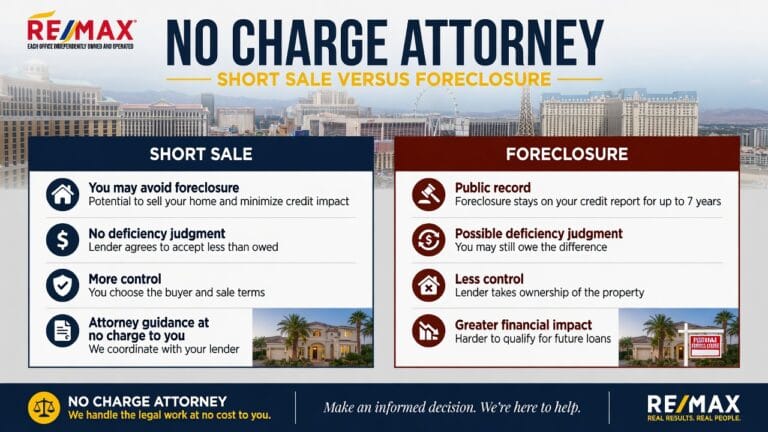
Our No Charge Short Sale Attorney reviews every lender package and approval letter at no extra cost to you.
The attorney steps in to handle direct talks with the banks and junior lien holders.
This includes pushing for a clear written waiver of any remaining balance, checking the final numbers, and making sure the terms protect you under Nevada rules before you sign.
How a short sale Works Step by Step
A short sale is not a foreclosure. In a foreclosure the lender takes the house through a legal process and you lose control.
It is not a deed in lieu, where you simply hand over the title.
It is not a regular cash offer when you have equity.
The key difference is that the lender must approve the price and release the lien.
Lenders in Clark County often prefer a short sale because foreclosure brings higher costs.
For many Las Vegas homeowners facing an underwater mortgage, a short sale protects more of their credit and shortens the time before they can buy again.
.
Key points
- You need proof of real money trouble plus an underwater or near-underwater loan. Just being underwater is not enough.
- Expect 4–6 months total.
- Credit score usually drops 85–160 points and stays on the report seven years. You can apply for a conventional loan after four years (seven years after foreclosure).
- Forgiven debt may count as taxable income. Check with a CPA about possible exclusions.
- Always get a written waiver of any remaining balance (deficiency) before you close.
Short sale versus foreclosure in Las Vegas
| Factor | Short sale | Foreclosure |
|---|---|---|
| Who starts it | You (with lender okay) | Lender |
| Time | 4–6 months | 90 days to 18 months |
| Credit drop | 85–160 points | 100–200+ points |
| Next conventional loan | 4 years | 7 years |
| Remaining balance | Can be waived in writing | Depends on Nevada rules |
| Control of price | You list and choose buyer | Auction sets the price |
| Move-out | You set the date | Court or lender decides |
Nevada law limits deficiency judgments on many purchase-money loans for primary homes taken out after October 1, 2009, if you meet strict rules (single-family home, continuous occupancy, no refinance, financial-institution lender).
Still, never rely only on the statute.
Demand a clear written waiver in the approval letter for the first mortgage and every junior lien.
Do you qualify?
Lenders look for four things:
- Documented hardship (job loss, medical bills, divorce, death, rate reset, or clear inability to pay soon).
- The market price will not cover the full payoff, including fees and second loans.
- You cannot make payments now or will not be able to soon.
- Complete paperwork.
Check a current value first.
Many Las Vegas owners think they are underwater when home prices have risen enough for a normal sale.
The process
- Call the loss-mitigation number on your mortgage statement and ask for the short sale packet. Keep paying unless the lender tells you in writing to stop.
- Gather the hardship package: letter, recent pay stubs or unemployment proof, two years of tax returns, two months of bank statements, budget worksheet, and the lender’s affidavit.
- Hire a Las Vegas agent who has closed multiple short sales. Volume matters more than fancy titles.
- Price the home at a realistic market level. Lenders reject offers far below their own value estimate.
- When you accept an offer, send the full package (contract, buyer funds proof, updated hardship docs) to the lender.
- The lender orders its own value opinion and, if needed, gets investor approval. Review often takes 30–120 days.
- Read the approval letter carefully with a local real-estate attorney. It must state the accepted price, closing deadline, and whether the remaining balance is waived.
- Close. Title pays the liens as ordered and the lender releases the mortgage.
Junior liens (second mortgages, HELOCs, HOA balances) each need their own written approval and can add four to eight weeks.
Realistic timeline
- Paperwork: 2–4 weeks
- Listing and offer: 30–90 days (Las Vegas market times vary by price and neighborhood)
- Lender review: 30–120 days
- Approval to close: 30–45 days
Total: usually 4–6 months.
Extra liens stretch it longer.
Hardship letter tips
Keep it short and factual.
- Name the exact event and date.
- Show numbers: old income, new income, mortgage payment, other must-pay bills.
- List what you already tried (payment plan, forbearance, savings).
- State why a short sale is the only workable option left.
- Ask in writing for a deficiency waiver.
Taxes
The lender may send a Form 1099-C for the forgiven amount.
That can be taxable income.
Some exclusions exist for insolvency or older debt-relief rules.
Complete an insolvency worksheet with a CPA before you sign the approval letter.
Credit impact
Expect an 85–160 point drop.
The mark lasts seven years from the first missed payment.
Waiting periods for a new loan:
- Conventional: 4 years after short sale, 7 after foreclosure
- FHA: 3 years
- VA: often 2 years
- USDA: 3 years
Alternatives worth checking first
- Loan modification if income has stabilized
- Temporary forbearance for a short-term problem
- Refinance (rare when underwater)
- Deed in lieu (faster but similar credit hit)
- Regular sale only if a current value covers the full payoff
Bottom line for Las Vegas owners
Start with a free HUD-approved counselor.
Confirm your home’s current value.
If you are truly underwater and have documented hardship, a short sale usually beats foreclosure on credit recovery and future buying power.
Never close without a written deficiency waiver reviewed by a Nevada real-estate attorney.
For tax questions, speak with a CPA, not an article.
Diana Valento RE/MAX Reliance
Diana Valento of RE/MAX Reliance is a Las Vegas real estate agent who specializes in short sales.
With more than 16 years of local experience, Nevada license S.0169007, and the SFR (Short Sale and Foreclosure Resource) designation, she helps homeowners gather hardship documents, work with lenders, and move through the approval process in Clark County.
Through our No Charge Attorney short sale program, clients receive legal review of the approval letter and deficiency waiver at no extra cost.
This added support helps protect against remaining balance risks under Nevada rules while Diana handles the listing, pricing, and the attorney handles lender negotiations.